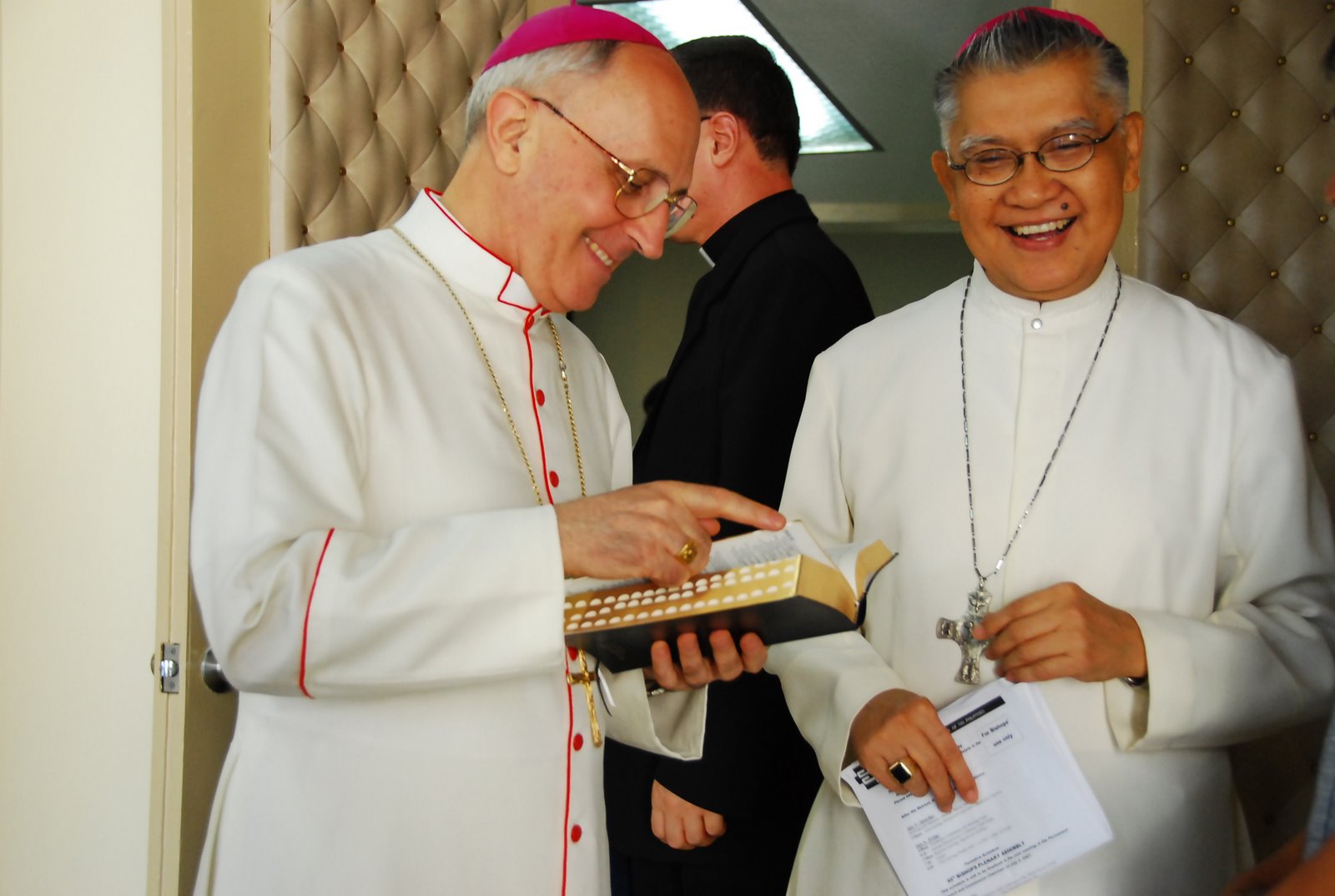
(Last March 9, 2006, the presentation of a Workbook on “Spirituality in the Workplace” by Ms. Isabelita S. Palanca, Professor at the University of Santo Tomas, was held at the CBCP Lanai Room. It was attended by some people from the academe, business and studentry, and members from Women’s Business Council, Bishops-Business Conference and Brotherhood of Christian Business and Professionals.)
Last January, the CBCP presented a goal on which a roadmap for the Philippine public life could be conceptualized. The CBCP said in its Pastoral Statement “what clearly emerges is the continued and urgent need for renewal on the public life of our country” through the adoption of correct moral values.
The CBCP has declared 2006 as “Social Concerns Year” under the auspices of the Sacred Heart of Jesus and the Immaculate Heart of Mary. One of our social concerns is the condition or circumstances of the working population, such as: the workers, the laborers in the farms, in industry, in factories, in plantations and in government offices. Included in the list are health workers, media practitioners and church workers. The welfare of the country depends on them more than on politicians.
I am happy to recognize that one has presented a workbook on “The Spirituality in the Workplace.” This has been scholarly prepared by Ms. Isabelita “Sabsy” Palanca under the guidance of a Salesian, Fr. Ely7 Santos, SDB, a Jesuit, Fr. Tony de Castro, SJ, and Dominican, Fr. Mon Merino, OP.
The vision of “Spirituality in the Workplace” is to offer an instrument for transforming workplaces as “Communities with Ethics and Governance.” Its mission is to trailblaze a movement among our workers that will renew public life through moral values. The workplaces and the workers are a very important segment of Philippine society. More than 60% of our population are workers of some sort, professional and non-professional. They too should be object and subject of social transformation in the country.
These workers are the ones supplying food in the tables of the wealthy and the governing class. These are the same workers who are in the C, D, and E classes, whose families suffer many disadvantages, from lack of food, education, social and health benefits.
The Bishops-Businessmen’s Conference on Human Development has taken interest in Ms. Palanca’s work because it believes that Catholic Social Principles must be lived and applied in the workplaces. The workers all too often suffer from human rights violations. At the same time they have to be made aware of the rights of the people they work with and work for.
We must start the education in moral values and human rights from the beginning. We advocate that Catholic schools, colleges and universities be the foremost proponents of formation in moral values and human rights. When the government takes care of the workers, the workers will take care of the country.
Saturday, March 11, 2006


Tuesday, February 28, 2006
SOWING SEEDS OF HOPE THROUGH MORAL VALUES
(A Talk delivered at the Institute for Solidarity in Asia on February 28, 2006)
The Catholic Bishops of the Philippines have been issuing pastoral letters to provide a moral compass for the decisions being made or proposed for the common good of our people. We can not stop doing what it is our duty to do: to remind our people and those who purport to lead them that core values drawn from natural law and the eternal law should serve as the moral foundations upon which we further build our nation.
Foundations securely a anchored on morals, and therefore on ethics, social responsibility and good governance make the institutions in our country strong; and such strong institutions can then work together to enhance the personal dignity of every individual as well as to promote the common good of our country. This happens, however, only if the agents of change and the transmitters of values in our society are empowered and invested with a deep sense of responsible citizenship. The family, the school, the business enterprise, and governance units at all levels should be at the forefront of our attention: through them we should ensure that all the programs we formulate, the projects we undertake, the targets we set, as one national community, are pervaded with the proper values that lead to the genuine development of our people.
Considering the social, economic, political and cultural imbalances and crises we are in, our vision of renewing Philippine public life is almost like a utopian dream. Both EDSA People Power I and II—successful and non-violent revolutions—stand in support of this dream. But we want this dream to become a growing passion and an obsession for every Filipino. To achieve this, we need to have at least a critical mass of nationalists who are willing to jump on to the beginning of a new political wave, to move into a new cycle of development, to operate with a social consciousness and conscience not for their individual or group safety and security, but for the good of the greatest number. We need servant-prophets of a new social order.
The scientist, Albert Einstein, offered a formula for solving the problems and crises that institutions, governments and churches are facing when he said: “The significant problem we face today cannot be solved at the same level of thinking we were at when we created them.” We will not solve our problem by insisting on doing the things that have produced the problem. Jesus Christ began his public ministry with a similar message “The time fulfillment has come…Repent (i.e. change your mind and behavior), and believe in the Gospel” (Mk. 1/15). The great Apostle Paul gives his rejoinder: “Be renewed in the spirit of your minds, and clothe yourselves with the new self, created according to the kindness of God in true righteousness and holiness” (Eph. 4/23).
The National Roadmap that has been unveiled fortunately captures these core ideas and invites all sectors of our society to taken them into so serious and account as to actually try to observe them. It establishes a fundamental and essential link between core values and strategic programs. It calls for full consistency between our core values and the measures we take, the targets we set, and the initiatives we undertake. Moreover, it asks all the drivers of change—the family, the school, the business enterprise, the governance units, and I might add all sectors of our society—to begin posing this question: what can we do for the common good of our national community? And in trying to answer this question, it strongly suggests that whatever answer we give must be fully consistent with the vision and mission we should have for our country and the core values that should underlie all aspects of our national life.
The most seriously affected by the crisis of moral values in the country are the poor, the marginalized, oftentimes exploited and treated like commodities. Graft and corruption have been flagrant and endemic, breeding poverty. Widespread poverty in turn breeds graft and corruption. The crisis of leadership at the highest level is like the tip of an “iceberg.” There is a concatenation of corruption that goes down to the barangay level, up and down and up, infecting the whole body politic like a contagious cancer. It deprives the poor of permanent shelter, health benefits, liberating education, dignified employment and above all sufficient food. To cure this social cancer we need a new breed of leaders in our country.
We must be able to gather a critical mass of like – minded and good willed nationalists, with a passion and obsession for good governance and prophetic leadership. This critical mass will be the training ground of other nationalists who will lead our country with the values of honesty and justice, truth and integrity, credibility and accountability, transparency and stewardship. These are the values—criteria that citizens must use to raise up a new breed of statespersons.
I fully this approach, I commend it to every sector and institution of our country. Follow it and make sure core values permeate all programs, targets and initiatives proposed and subsequently taken, monitored, and scored! It is the link between core values and decisions as well as actions we have been taking that has been missing for too long in our country. For as long as that link remains missing, we end up with more than a few leaders who act more like a band of thieves rather than as a band of responsible statespersons deeply committed to the common good of all.
+ANGEL N. LAGDAMEO
28 February 2006
(A Talk delivered at the Institute for Solidarity in Asia on February 28, 2006)
The Catholic Bishops of the Philippines have been issuing pastoral letters to provide a moral compass for the decisions being made or proposed for the common good of our people. We can not stop doing what it is our duty to do: to remind our people and those who purport to lead them that core values drawn from natural law and the eternal law should serve as the moral foundations upon which we further build our nation.
Foundations securely a anchored on morals, and therefore on ethics, social responsibility and good governance make the institutions in our country strong; and such strong institutions can then work together to enhance the personal dignity of every individual as well as to promote the common good of our country. This happens, however, only if the agents of change and the transmitters of values in our society are empowered and invested with a deep sense of responsible citizenship. The family, the school, the business enterprise, and governance units at all levels should be at the forefront of our attention: through them we should ensure that all the programs we formulate, the projects we undertake, the targets we set, as one national community, are pervaded with the proper values that lead to the genuine development of our people.
Considering the social, economic, political and cultural imbalances and crises we are in, our vision of renewing Philippine public life is almost like a utopian dream. Both EDSA People Power I and II—successful and non-violent revolutions—stand in support of this dream. But we want this dream to become a growing passion and an obsession for every Filipino. To achieve this, we need to have at least a critical mass of nationalists who are willing to jump on to the beginning of a new political wave, to move into a new cycle of development, to operate with a social consciousness and conscience not for their individual or group safety and security, but for the good of the greatest number. We need servant-prophets of a new social order.
The scientist, Albert Einstein, offered a formula for solving the problems and crises that institutions, governments and churches are facing when he said: “The significant problem we face today cannot be solved at the same level of thinking we were at when we created them.” We will not solve our problem by insisting on doing the things that have produced the problem. Jesus Christ began his public ministry with a similar message “The time fulfillment has come…Repent (i.e. change your mind and behavior), and believe in the Gospel” (Mk. 1/15). The great Apostle Paul gives his rejoinder: “Be renewed in the spirit of your minds, and clothe yourselves with the new self, created according to the kindness of God in true righteousness and holiness” (Eph. 4/23).
The National Roadmap that has been unveiled fortunately captures these core ideas and invites all sectors of our society to taken them into so serious and account as to actually try to observe them. It establishes a fundamental and essential link between core values and strategic programs. It calls for full consistency between our core values and the measures we take, the targets we set, and the initiatives we undertake. Moreover, it asks all the drivers of change—the family, the school, the business enterprise, the governance units, and I might add all sectors of our society—to begin posing this question: what can we do for the common good of our national community? And in trying to answer this question, it strongly suggests that whatever answer we give must be fully consistent with the vision and mission we should have for our country and the core values that should underlie all aspects of our national life.
The most seriously affected by the crisis of moral values in the country are the poor, the marginalized, oftentimes exploited and treated like commodities. Graft and corruption have been flagrant and endemic, breeding poverty. Widespread poverty in turn breeds graft and corruption. The crisis of leadership at the highest level is like the tip of an “iceberg.” There is a concatenation of corruption that goes down to the barangay level, up and down and up, infecting the whole body politic like a contagious cancer. It deprives the poor of permanent shelter, health benefits, liberating education, dignified employment and above all sufficient food. To cure this social cancer we need a new breed of leaders in our country.
We must be able to gather a critical mass of like – minded and good willed nationalists, with a passion and obsession for good governance and prophetic leadership. This critical mass will be the training ground of other nationalists who will lead our country with the values of honesty and justice, truth and integrity, credibility and accountability, transparency and stewardship. These are the values—criteria that citizens must use to raise up a new breed of statespersons.
I fully this approach, I commend it to every sector and institution of our country. Follow it and make sure core values permeate all programs, targets and initiatives proposed and subsequently taken, monitored, and scored! It is the link between core values and decisions as well as actions we have been taking that has been missing for too long in our country. For as long as that link remains missing, we end up with more than a few leaders who act more like a band of thieves rather than as a band of responsible statespersons deeply committed to the common good of all.
+ANGEL N. LAGDAMEO
28 February 2006
Lent: A Call to Transformation
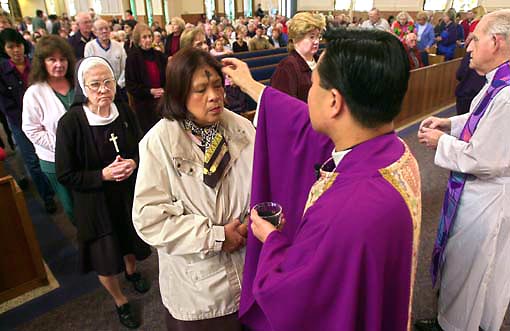 Ash Wednesday launches the Catholic Church into the season of lent. On Ash Wednesday we are given a grim reminder by the church “You are dust, and unto dust you shall return.” The liturgy allows the use of Jesus Christ’s inaugural message as he entered his public life: “Repent and believe in the Gospel.” (Mk 1:15). This is said as the ashes are imposed on the forehead.
It is season of Lent. “Quaresma,” it is also called. Season of penance and mortification. Season of “pabasa,” the common singing of “pasyon.” Season of the Stations of the Cross every Friday. The season leads to Palm Sunday… the Visita Iglesya on Holy Thursday…the Seven Last Words on Good Friday…the Empty Tomb on Easter Sunday.
Jesus Christ’s invitation of “Repent” in this season of lent takes on a peculiar perspective in the context of our national situation. It is a call to transformation. Considering the social, economic and political crises we are in, the vision of change and transformation becomes a growing passion and obsession. We want the Resurrection to new life brought by Jesus Christ on Easter Sunday observed and experienced not only on the spiritual level but also as a transformation in our economic, social and political life.
Lent as a call to transformation means that out of the repentance of believers in the Gospel, the slum dwellings are transformed to permanent shelters, the poor are given health benefits, the marginalized are offered liberating education, the exploited are given dignified employment and malnourished children sufficient food. Transformation of society is the fruit of repentance and reform of life.
While political priorities occupy many of our leaders, the most immediate and urgent priority of the common Filipinos is their daily struggle to earn their livelihood. Poverty, despite the professed development at the macro-level, remains the heaviest burden the country bears.
I repeat what the Bishops had said in their Pastoral Statement Renewing Our Public Life: “At the bottom of our political chaos is a crisis of moral values, a crisis of truth and justice, of unity and solidarity for the sake of the common good and genuine peace.” Renewal of moral values in the service of the common good means converting the energies that one used for graft and corruption into energies for better public service. We hope that from the “ashes” of political crisis and corrupted institutions will resurrect a transformed nation, a truly moral society, built up in truth, justice, freedom and love.
+ANGEL N. LAGDAMEO
Archbishop of Jaro
President, Catholic Bishops’ Conference of the Philippines
February 28, 2006
Subscribe to:
Posts (Atom)